Sun unleashes colossal solar flare and coronal mass ejection, raising the chances of northern lights this week
Space.com ·
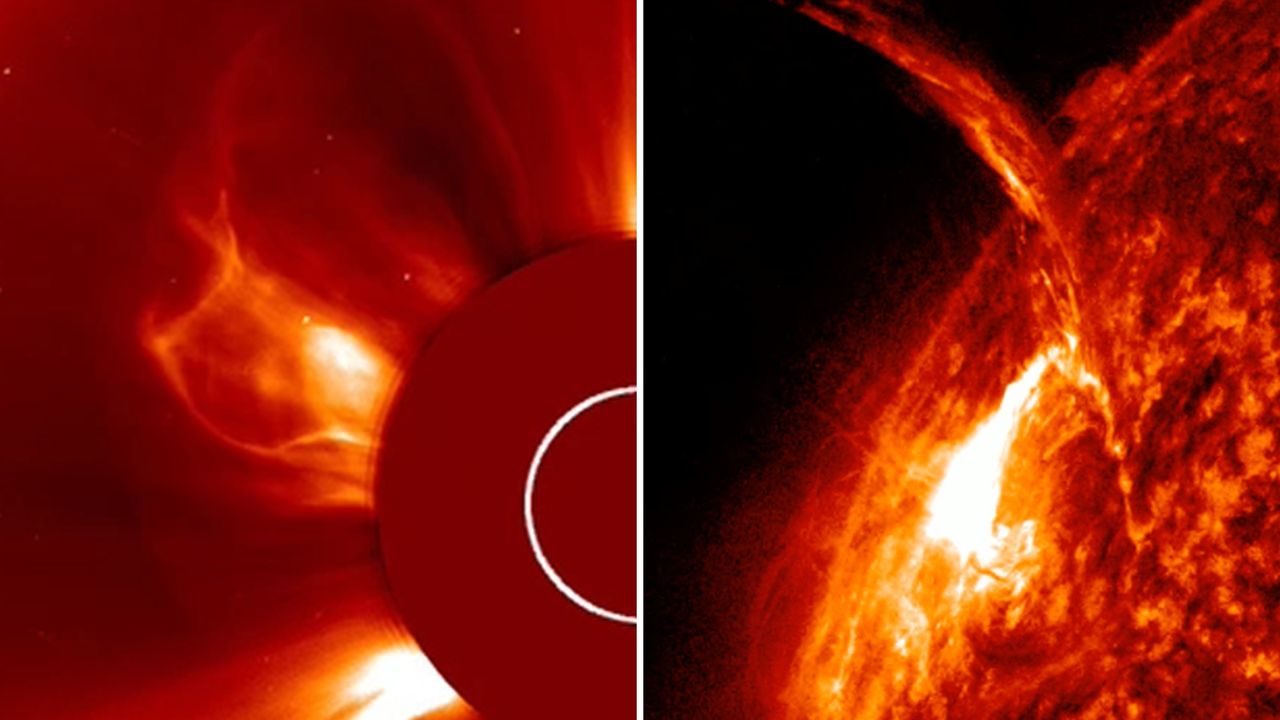
CME eruption in upper left corner. The bright speck of light to the right is Mercury. (Image credit: SOHO LASCO C3) A powerful M5.7 solar flare erupted from the sun on May 10, unleashing an …
CME eruption in upper left corner. The bright speck of light to the right is Mercury. (Image credit: SOHO LASCO C3) A powerful M5.7 solar flare erupted from the sun on May 10, unleashing an impressive coronal mass ejection (CME) that could deliver Earth a glancing blow later this week and potentially spark northern lights displays at high latitudes. The eruption peaked at 9:39 a.m. EDT (1339 GMT) from sunspot region AR4436, now rotating into Earth's "strike zone" on the sun 's northeastern limb. As the active region swings further into view over the next few days, any major flares or CMEs it produces will have a greater chance of being directed toward Earth. While most of the recently launched CME appears to be racing east of Earth, NOAA's Space Weather Prediction Center and the U.K. Met Office say part of the expanding plume of solar material may still brush past Earth around early May 13. If that happens, it could trigger minor (G1) geomagnetic storm conditions, enhancing aurora displays across the northern U.S. and the U.K. The M5.7 solar flare triggered radio blackouts on the sunlit portion of Earth at the time of the eruption. (Image credit: NOAA Space Weather Prediction Center) Solar flares are ranked using a scale A, B, C, M and X — the latter being the most powerful category. Each step represents a tenfold increase in energy output. The May 10 event reached M5.7 strength, making it a powerful flare capable of disrupting radio communications on Earth. …
Original source: Space.com
Mentioned
United States · NOAA · Earth · Mexico · Florida · Atlantic Ocean