A brain reward circuit inhibited by next-generation weight-loss drugs in mice
Nature News ·
Mouse lines All experiments were conducted in compliance with the Association for Assessment of Laboratory Animal Care policies and approved by the Institutional Animal Care and Use Committees of the …
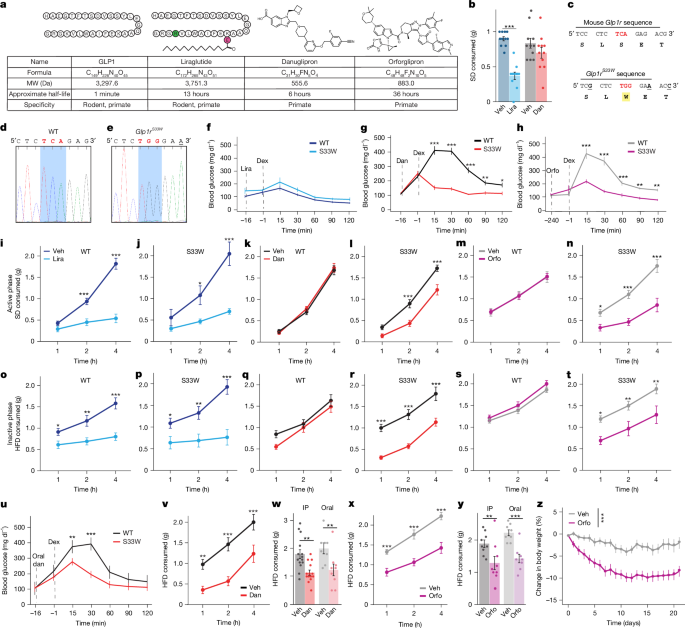
Mouse lines All experiments were conducted in compliance with the Association for Assessment of Laboratory Animal Care policies and approved by the Institutional Animal Care and Use Committees of the University of Virginia, University of Washington and University of California, Irvine. Mice were housed on a 12-h:12-h light–dark (LD) cycle with food (PicoLab Rodent Diet 5053) and water provided ad libitum unless otherwise indicated. For experiments, we used 8-week or older male and female C57BL/6J mice, Glp1r-IRES-Cre mice (Glp1rtm1.1(cre)Lbrl/RcngJ, strain 029283, RRID: IMSR_JAX:029283 ), Glp1r-IRES-Cre mice crossed to the Ai14 tdTomato reporter line (B6.Cg-Gt(ROSA)26Sortm14(CAG-tdTomato)Hze/J, strain 007914, RRID: IMSR_JAX:007914 ), Glp1r flox/flox mice (B6(SJL)-Glp1rtm1.1Stof/J, strain 035238, RRID: IMSR_JAX:035238 ), Dat-Cre mice (B6.SJL-Slc6a3tm1.1(cre)Bkmn/J, strain 006660, RRID: IMSR_JAX:006660 ) Gcg-Cre mice (C57BL/6J-Tg(Gcg-cre)-1Mmsc/Mmmh, stock 051056-MU, RRID: MMRRC_051056-MU ) and Glp1r S33W mice (described below). Gcg-Cre mice were rederived by in vitro fertilization from frozen sperm (MMRRC, 051056-MU). Approximately equal numbers of males and females were used per group unless otherwise specified. Generation of Glp1r S33W mice The Glp1r S33W mouse line was generated by CRISPR–Cas9 homologous repair at the University of Virginia Genetically Engineered Murine Model Core. In brief, Cas9 (Alt-R S.p. …
Original source: Nature News