Imaging the flat bands of magic-angle graphene reshaped by interactions
Nature News ·
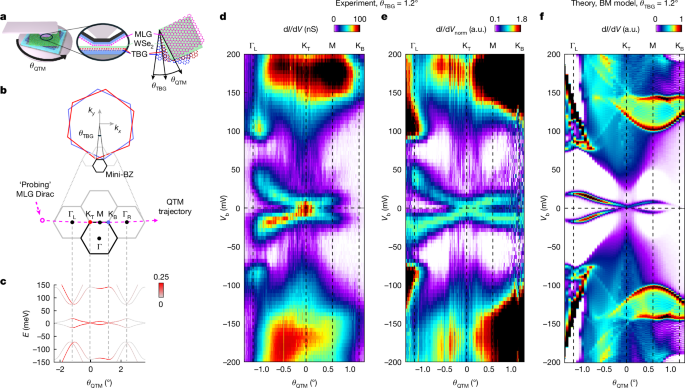
Cryogenic QTM All measurements in this work were performed in a cryogenic QTM system operating at a temperature of 4 K, as described previously 45 . …
Cryogenic QTM All measurements in this work were performed in a cryogenic QTM system operating at a temperature of 4 K, as described previously 45 . For conductance measurement, voltage biases are applied using a custom-built digital-to-analogue converter array, capable of supplying both d.c. and a.c. signals with 1 μV resolution. Currents were measured using a FEMTO current amplifier, followed by a National Instruments sampler. Fabrication and characterization of the QTM tip and van der Waals device The fabrication of both QTM tips and van der Waals devices on flat substrates were described previously 45 , 46 . Briefly, we use the standard dry transfer and polymer membrane transfer techniques to fabricate the TBG sample and the QTM tip, respectively. Extended Data Fig. 1a shows an optical image of the TBG heterostructure, comprising bilayer-WSe 2 /TBG/hexagonal boron nitride (h-BN)/Pt on an approximately 100 μm width and 80 μm tall Si/SiO 2 pillar. Extended Data Fig. 1b shows an optical image of the MLG backed by h-BN and graphite placed on a QTM tip. In Extended Data Fig. 1c , we characterize the TBG sample by conductive AFM scan of the region of magic twist angle carried out at room temperature (Bruker Icon). To compensate for the thermal drift during this AFM scan, we performed a small window scan at rate 10.9 Hz, such that the time for an entire scan is around 20 s. We apply an approximately 1 V d.c. …
Original source: Nature News