Foreshock-induced slip transients set mainshock nucleation timing
Nature News ·
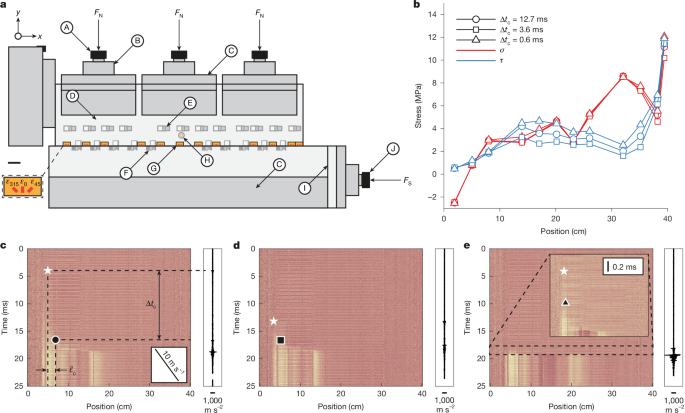
Experimental set-up A biaxial apparatus, CrackDyn, was used to perform the experiments (Fig. 1a ). The apparatus housed two PMMA plates (40 × 10 × 1 cm and 45 × 10 × 1.8 cm). …
Experimental set-up A biaxial apparatus, CrackDyn, was used to perform the experiments (Fig. 1a ). The apparatus housed two PMMA plates (40 × 10 × 1 cm and 45 × 10 × 1.8 cm). Experiments were conducted on PMMA rather than natural rocks because it provides three main advantages for scaling laboratory observations to natural fault systems. First, owing to its lower elastic stiffness compared with rocks, the state-evolution slip distance, L , and cohesive zone size, X c , are smaller in PMMA. As a result, a laboratory-scale PMMA fault is dynamically representative of a much larger natural fault, whereas a laboratory rock fault essentially remains of the same scale as its natural counterpart. Second, the reduced elastic properties and fracture energy, G c , of PMMA ensure that nucleation lengths, ℓ c and ℓ ∞ , remain smaller than the total fault dimension in the experiment, which is rarely the case in rocks, in which nucleation patches can be comparable with or larger than the laboratory fault. Finally, the birefringent properties of PMMA allow for photoelastic visualization, enabling direct observation of nucleation growth and subsequent rupture propagation using high-speed imaging. The plates were characterized by a static Young’s modulus, E , of 3 GPa and a Poisson’s ratio, ν , of 0.35. A normal load was applied by three vertical pistons by means of steel sample holders. The pistons were supplied by a Enerpac P141 hydraulic pump. …
Original source: Nature News