Pollinators support the nutrition and income of vulnerable communities
Nature News ·
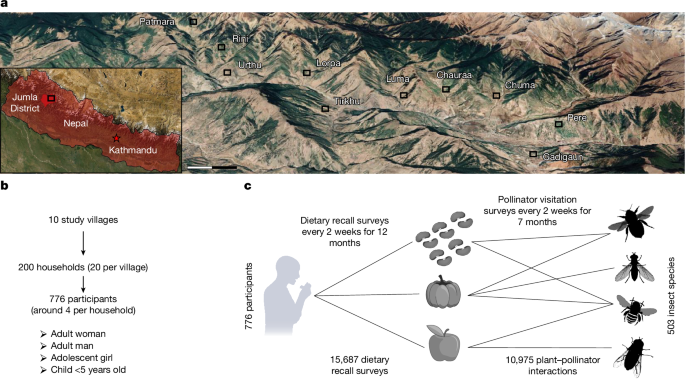
Study sites Field work took place in ten smallholder farming villages (2,400–3,000 metres above sea level, temperate climate) in Jumla District, Nepal (Fig. 1 , Supplementary Fig. …
Study sites Field work took place in ten smallholder farming villages (2,400–3,000 metres above sea level, temperate climate) in Jumla District, Nepal (Fig. 1 , Supplementary Fig. 2 and Supplementary Method 2 ). Jumla is a remote mountainous district, situated in the Karnali Province of western Nepal. Rates of poverty, food insecurity and malnutrition are very high in this region, and 80% of the population directly depends on smallholder agriculture 47 . The study populations are typical of many smallholder communities around the world (Supplementary Fig. 1 ) and are characterized by a heavy reliance on small (87 cm in height), whereas length (that is, lying down) was recorded for children under 2 years old or 75% of pollinator-dependent food consumption and >90% of farming income. Yield gaps were defined as the difference between the upper-95 percentile yield and the median yield across farms in our study region. We then assumed that a part of this yield gap (median of 24%) could be closed, drawing on data from a global study of comparable smallholder farms in Asia (including Nepal), Africa and Latin America that quantified the fraction of yield gaps attributable to insufficient pollination 36 . Notably, we only closed this pollination-related share of the yield gap, whereas the larger proportion caused by other agronomic constraints (for example, fertilizer, water and soil quality) was left unchanged. …
Original source: Nature News
Mentioned
Asia · Africa · Nepal · Latin America