The exotic particles that could finally break the Standard Model
Nature News ·
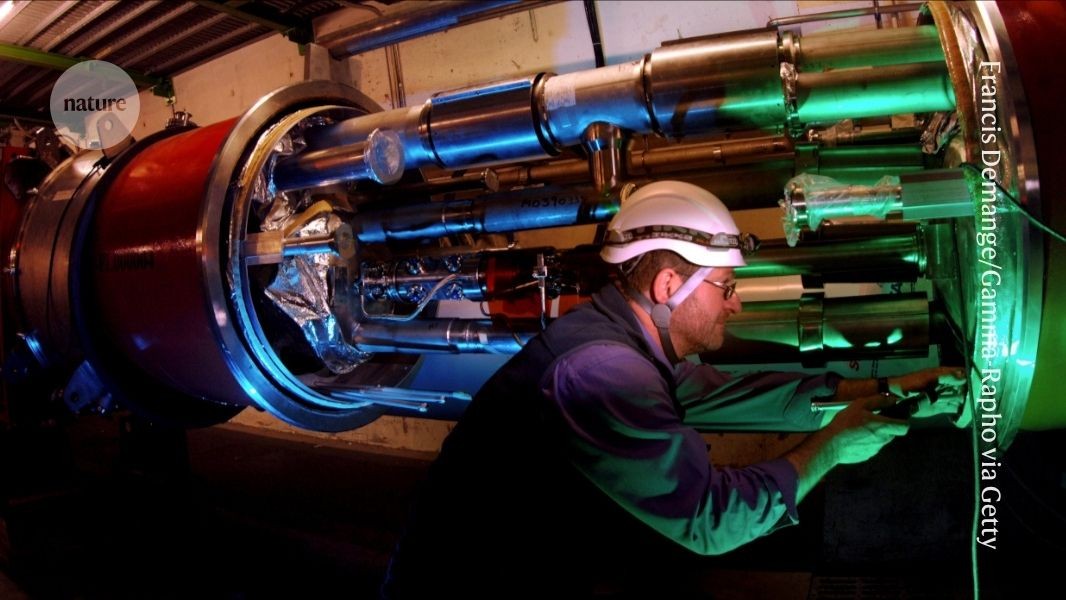
An engineer works on equipment for the LHCb experiment inside the tunnel of the Large Hadron Collider. Credit: Francis Demange/Gamma-Rapho via Getty Physicists know that their elegant theoretical …
An engineer works on equipment for the LHCb experiment inside the tunnel of the Large Hadron Collider. Credit: Francis Demange/Gamma-Rapho via Getty Physicists know that their elegant theoretical description of forces and particles – the Standard Model – must be incomplete, because there are a host of phenomena it cannot explain, such as the existence of dark matter. But observations continue to confirm the model’s accuracy with ever greater precision. Even measurements that seemed to break the mould, such as a discrepancy in the mass of a particle called the W boson , have evaporated under further investigation. Now, an analysis from an experiment at the Large Hadron Collider (LHC) at CERN, Europe’s particle physics laboratory near Geneva, Switzerland, suggests that one deviation from the Standard Model has grown. It concerns the decay of particles called B mesons into other particles. The result, which has been accepted for publication in Physical Review Letters , is one of the last remaining anomalies for particle physicists, who look for new physics in the debris from proton-proton collisions that turn energy into matter. Nature explores the latest findings from CERN’s LHCb experiment, and the exotic particles that could explain them. What did the experiment find? Rather than looking for new, heavy particles directly, LHCb looks indirectly for their subtle effects, including when they pop up fleetingly as “virtual particles” that influence decays. …
Original source: Nature News
Mentioned
Switzerland · Cambridge University · Quantum · University of Edinburgh