Why cows burp methane: new ‘cellular organ’ discovered in gut microbes
Nature News ·
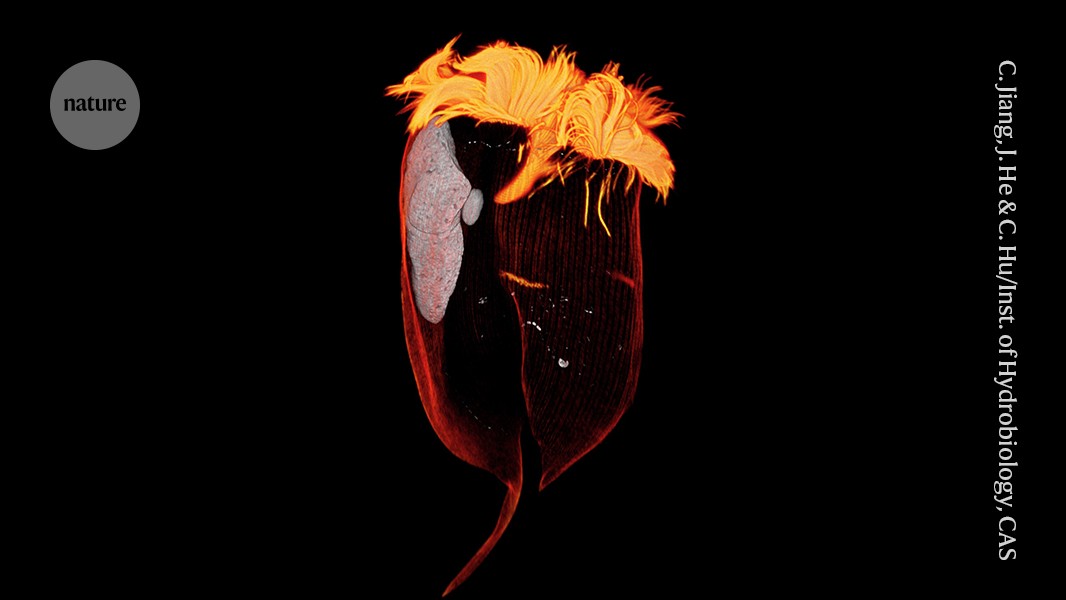
The newly discovered organelle was found in ciliates (like this Entodinium caudatum ). These eukaryotic organisms live in the rumen of herbivores. Credit: Chuanqi Jiang, Jinying He & Che Hu/Inst. …
The newly discovered organelle was found in ciliates (like this Entodinium caudatum ). These eukaryotic organisms live in the rumen of herbivores. Credit: Chuanqi Jiang, Jinying He & Che Hu/Inst. of Hydrobiology, CAS Scientists have identified a new type of cellular organelle inside microbes that live in the guts of ruminant animals such as sheep and cows. In a paper published in Science on 30 April 1 , researchers describe an oval-shaped structure that they discovered inside rumen ciliates — a type of single-celled organism that lives inside ruminants. These subcellular structures, called hydrogenobodies, were found to contribute to the generation of methane livestock. The organelle removes oxygen and releases hydrogen, which archaea in the rumen use as fuel to produce methane. Burping livestock contribute around 30% of global methane emissions produced by human activities, and the authors say their discovery could inspire new ways to reduce these emissions. “This opens new opportunities to modulate the rumen microbiome more precisely” to make animals’ digestion more efficient and lower the methane they produce, says Oscar Gonzalez-Recio, a geneticist who studies the rumen microbiome at the University of Edinburgh, UK. Tiny emitters Ciliates make up 25% of microbial mass in the rumen — a specialized stomach compartment in ruminants that acts as a fermentation vat to break down plant matter. …
Original source: Nature News
Mentioned
Wuhan · China · Ohio State University · University of Edinburgh