Long-lived immune cells show promise against cancer in world-first trial
Nature News ·
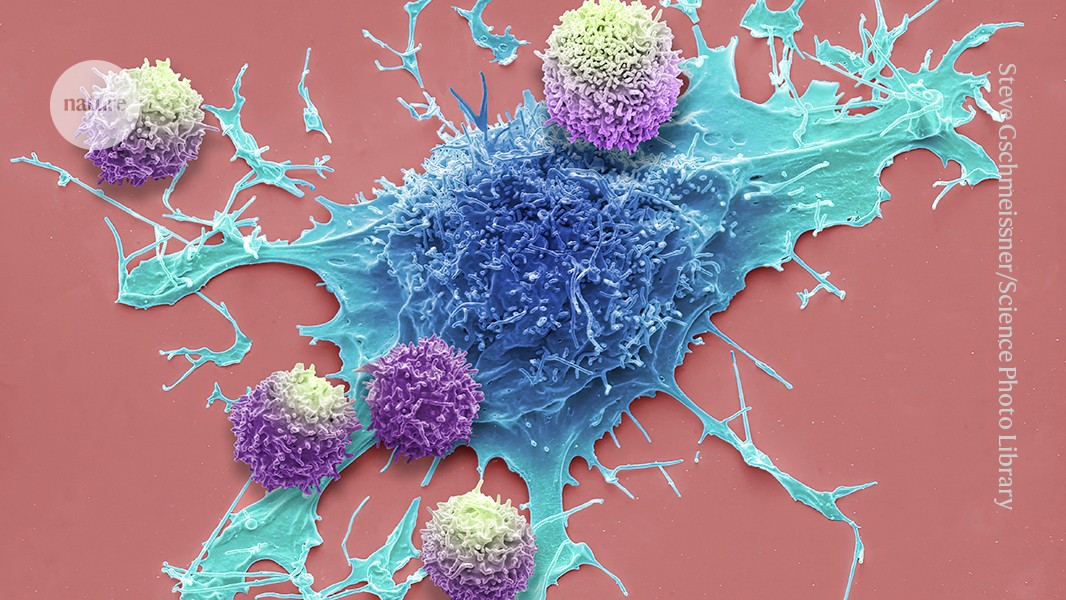
Conventional CAR T cells (purple and yellow spheres; artificially coloured) attack a cancer cell. Credit: Steve Gschmeissner/Science Photo Library The first clinical trial to test the tumour-fighting …
Conventional CAR T cells (purple and yellow spheres; artificially coloured) attack a cancer cell. Credit: Steve Gschmeissner/Science Photo Library The first clinical trial to test the tumour-fighting power of a stem-cell-like class of long-lived immune cells suggests that they could be more potent and less toxic than the standard mix of cells used in therapies for cancer . The study, published in Cell on 30 April 1 , was small, and larger trials are needed to establish the treatment’s effectiveness. But the early results are promising: of 11 people with difficult-to-treat blood cancers, 5 entered remission after receiving a treatment called CAR-T-cell therapy that contained an unusually high proportion of immune cells with properties similar to stem cells. This formulation was effective at lower doses than normal CAR-T-cell therapy and produced milder side effects. “On a per-dose basis, these cells definitely seemed more potent,” says Christine Brown, who studies cancer immunotherapy at City of Hope, a cancer treatment centre and research institute in Duarte, California, who was not involved in the study. “It’s a first step, but an important one.” Many flavours Chimeric antigen receptor (CAR) T cell therapies reprogram immune cells called T cells to target and kill cancer cells. To make these complex, living drugs, researchers normally isolate T cells from the recipient’s blood and then genetically engineer them to express a protein that binds to cancer cells. …
Original source: Nature News